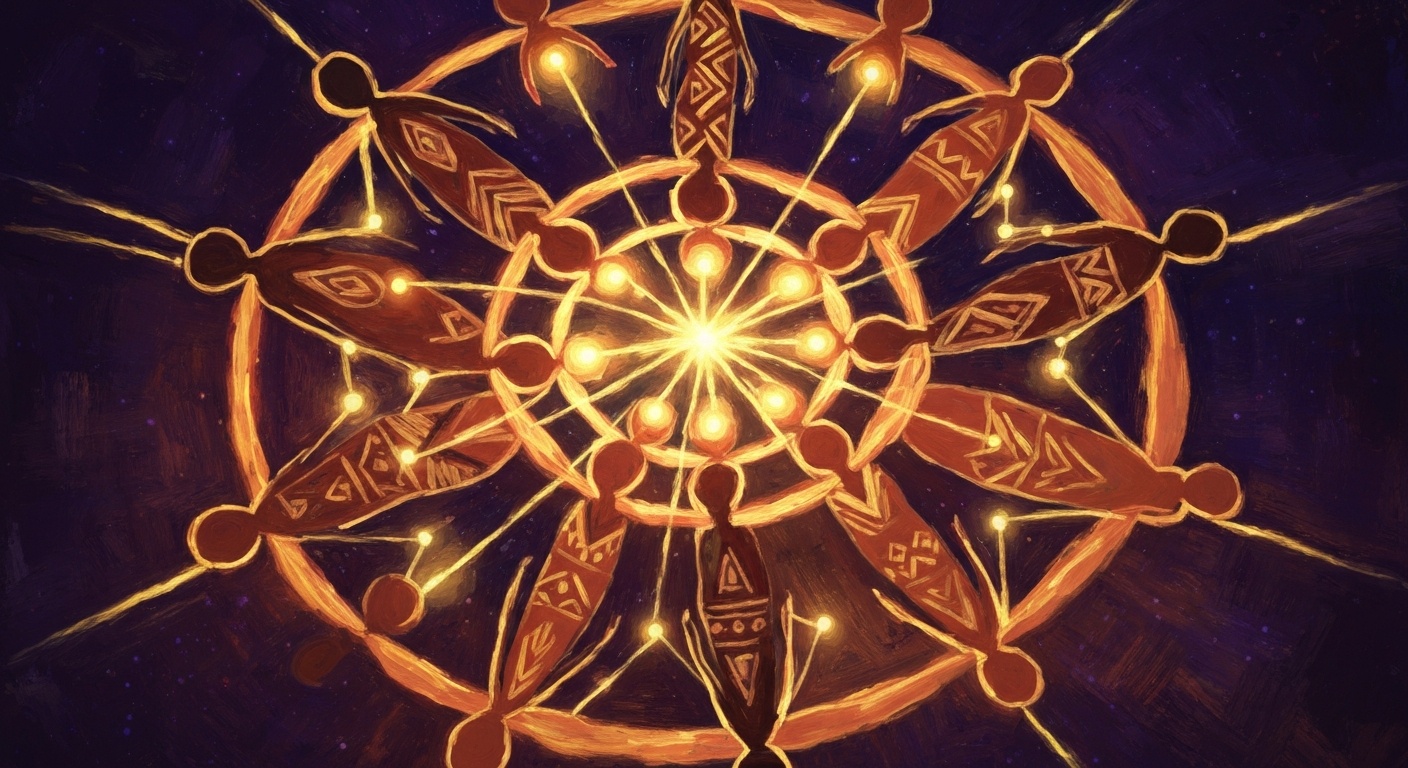
You've probably heard the word. Nelson Mandela spoke of it. Desmond Tutu wrote books about it. Tech companies named operating systems after it. But Ubuntu—and its Sesotho equivalent, Botho—is far more than a buzzword. It's a complete philosophical system that's now reshaping how African fantasy imagines worlds, magic, and heroism.
Ubuntu / Botho
"I am because we are" — A person is a person through other persons
What Ubuntu Actually Means
Western philosophy often starts with the individual. Descartes declared "I think, therefore I am"—locating existence in the isolated mind. Ubuntu starts somewhere radically different: existence is relational. You become fully human through your connections to others.
This isn't just abstract philosophy. It shapes everything:
- Ethics: Right action is what maintains and strengthens community bonds
- Identity: You are not a fixed self but a node in a web of relationships
- Responsibility: Your actions ripple outward; you are accountable to the whole
- Power: True authority serves the collective, not the self
In Sesotho, this concept is called Botho. The phrase "Motho ke motho ka batho" translates roughly as "A person is a person through people." It's not a slogan—it's an ontological claim about the nature of being.
Why Western Fantasy Struggles with Community
Think about the hero's journey that dominates Western fantasy. A special individual—often an orphan or outsider—discovers unique powers, overcomes personal obstacles, and achieves individual destiny. The community exists to be saved, not to constitute the hero's identity.
This model reflects Western individualism. It produces compelling stories, but it's not the only way to imagine heroism. And for readers seeking alternatives—for those exhausted by "chosen one" narratives—African fantasy offers something genuinely different.
"In stories built on Ubuntu, the question is never 'What is my destiny?' It's 'What does the community need me to become?'"
Botho ba ho Qala: Original Ubuntu in RESONANCE
In RESONANCE by Sitreyah Kotelo, the cosmic council called the Alaur (Circle of First Counsel) embodies what the text calls "Botho ba ho Qala"—Original Ubuntu, or the primordial ethic of interdependence.
This phrase does profound work:
- Botho – humanity-through-relationship, the ethical foundation
- ba ho Qala – "of the beginning/origin/primordial"
The implication is startling: the universe itself is structured on relational ethics. Ubuntu isn't a human invention imposed on neutral reality—it's the fundamental law of existence. The cosmos operates on interdependence, not competition.
This cosmological claim transforms how power, magic, and conflict work in the story. The Dominion—RESONANCE's antagonist force—represents the violation of Botho: extraction, isolation, the severing of connection. They don't just do evil things; they embody a philosophical error about the nature of reality.
How Ubuntu Changes Fantasy Worldbuilding
Magic as Relationship
In Ubuntu-based fantasy, magic isn't a personal resource to be hoarded and developed. It flows through connections. The Stone Shapers in RESONANCE access power through the Line of Remembrance—their link to ancestors and to each other. Isolation weakens; connection strengthens.
Heroism as Service
The protagonist Lefika doesn't seek personal power or individual glory. His journey is toward becoming what the community needs. His growth is measured not by increasing strength but by deepening relationship—to ancestors, to elders, to the land itself.
Villainy as Disconnection
The Dominion's evil isn't random cruelty. It's systematic: they sever people from ancestors, from land, from each other. They create isolated, controllable individuals. In Ubuntu terms, they're not just politically oppressive—they're ontologically destructive.
Resolution as Restoration
Victory in Ubuntu-based fantasy isn't the hero defeating the villain in single combat. It's the restoration of proper relationship—between people, between generations, between the living and the dead, between humanity and land.
Ubuntu in the Global Conversation
Ubuntu has already entered global consciousness through several channels:
- Post-apartheid South Africa: Mandela and Tutu used Ubuntu to articulate reconciliation philosophy
- Business and leadership: Ubuntu management styles emphasise collaborative decision-making
- Technology: The Ubuntu Linux operating system takes its name from this philosophy
- Education: Ubuntu pedagogy centres relationship-based learning
Fantasy fiction is the next frontier. As readers seek alternatives to individualist narratives—as climate crisis makes interdependence impossible to ignore—Ubuntu offers a philosophical foundation for imagining different kinds of worlds and different kinds of heroes.
For International Readers: Why This Matters
If you're reading from the UK, US, or elsewhere, Ubuntu-based fantasy offers more than exotic flavour. It offers a genuine alternative worldview—a different answer to fundamental questions about identity, power, and meaning.
Reading African fantasy built on Ubuntu is an exercise in philosophical expansion. You're not just encountering different characters or settings. You're encountering a different ontology—a different theory of what exists and how it's organised.
This is what "diverse fantasy" can mean at its deepest: not just characters who look different, but worlds that work differently. Worlds where the hero's journey isn't about becoming a powerful individual, but about becoming a proper person through right relationship.
"Ubuntu doesn't reject individual excellence. It redefines it. Excellence is measured by how much you contribute to the whole—how fully you become yourself through serving others."
The Philosophy in Practice
When you read RESONANCE, watch for how Ubuntu shapes narrative structure:
- Elders matter: Wisdom flows from accumulated relationship, not individual insight
- Ancestors are present: The dead remain in active relationship with the living
- Land is kin: Geography isn't backdrop but participant—another node in the relational web
- Power is responsibility: Greater gifts mean greater obligation to serve
These aren't arbitrary worldbuilding choices. They're Ubuntu expressed as narrative architecture. The philosophy becomes story.
Experience Ubuntu as Epic Fantasy
RESONANCE by Sitreyah Kotelo builds an entire fantasy cosmos on Ubuntu philosophy. Discover a world where connection is power, ancestors guide the living, and heroism means becoming what the community needs.
$4.99 / £3.99 / R89
Begin the Journey