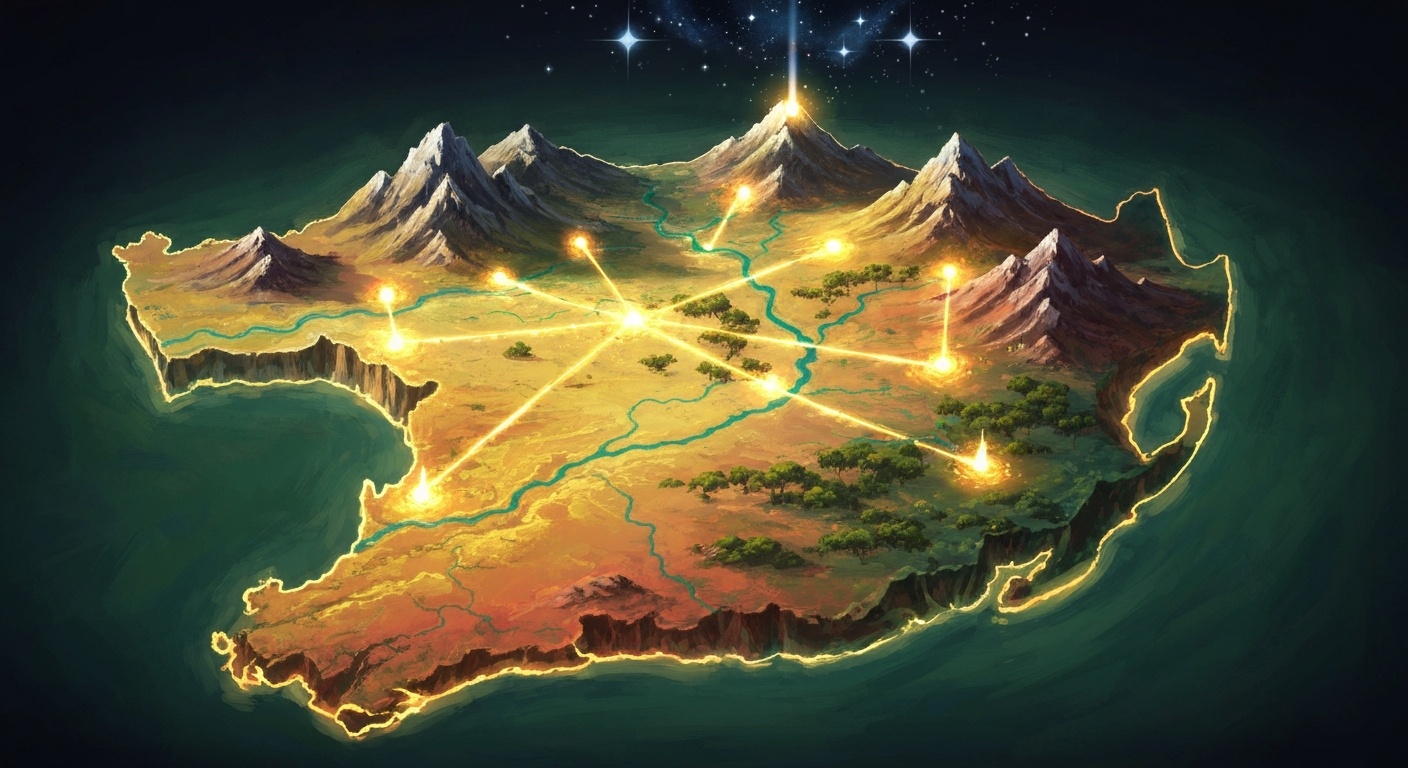
Colonisation didn't just take land and labour. It colonised imagination—establishing European geography as the default setting for "universal" stories while rendering African landscapes as exotic backdrop or dark continent. Fantasy literature, born from European folklore and medieval nostalgia, has been particularly colonised. Decolonising fantasy means reclaiming geography itself as storytelling space.
The Problem with Pseudo-Europe
Open most mainstream fantasy novels and you'll find yourself in some variant of medieval Europe: temperate forests, stone castles, feudal hierarchies, seasons that mirror the Northern Hemisphere. This isn't neutral worldbuilding. It carries assumptions:
- European geography is "normal"—the unmarked default for fantasy settings
- European history provides the template—kingdoms, knights, Christian-derived religion
- European folklore is universal mythology—dragons, elves, dwarves as standard fantasy furniture
- Other geographies are "exotic"—requiring explanation, justification, or explicit marking
For African readers, this creates a peculiar displacement. To enjoy fantasy, you must imaginatively relocate to landscapes you've never seen, seasons you've never experienced, social structures that never existed here. Your own geography becomes unsuitable for epic storytelling.
What Colonisation Took
Beyond physical land, colonisation systematically devalued African knowledge systems:
Sacred Geography Dismissed
Indigenous understanding of mountains, rivers, and forests as spiritually significant was labelled "superstition." Colonial mapping renamed places, erasing thousands of years of accumulated geographical knowledge.
Oral Traditions Silenced
African storytelling—including epic narratives, cosmological accounts, and heroic tales—was dismissed as "primitive" compared to written European literature.
Land Itself Stolen
The 1913 Natives Land Act confined Black South Africans to 13% of national territory. When you can't physically inhabit land, imagining epic stories set there becomes an act of longing.
History Erased
Civilisations like Aksum, Great Zimbabwe, and the Mali Empire were downplayed or attributed to non-African builders. African history was presented as beginning with colonial "discovery."
Fantasy as Decolonisation
When African writers centre African geography in fantasy, they perform several decolonising acts:
Reclaiming Imaginative Space
Every fantasy set in the Drakensberg rather than generic mountains declares: This land is worthy of epic stories. It refuses the colonial relegation of African landscapes to backdrop status.
Validating Indigenous Knowledge
Fantasy that treats sacred mountains, ancestral water sources, and stone memory-sites as real knowledge (not superstition) validates what colonialism tried to erase. The thin places aren't invented for the story—they're inherited from millennia of African spiritual practice.
Restoring Historical Continuity
Fantasy drawing on Aksum, Great Zimbabwe, or precolonial African polities restores what colonial historiography erased—the sense that Africa has deep, complex history worthy of mythological treatment.
Creating Recognition
For African readers, encountering familiar geography in fantasy creates powerful recognition. The highveld's light. The coastal humidity. The mountain mist. These recognitions say: You belong in epic stories.
"Decolonisation is not about swapping European furniture for African furniture in the same old rooms. It's about recognising that the rooms themselves were built to exclude us—and building new structures rooted in our own earth."
RESONANCE as Decolonised Geography
RESONANCE by Sitreyah Kotelo exemplifies decolonised fantasy geography in several ways:
Specific African Settings
The novel grounds itself in recognisable Southern African landscapes—the Drakensberg-inspired highlands of Tugella, climate patterns matching real SA zones, vegetation and weather that feel authentic to Mzansi readers.
Indigenous Knowledge as Primary
The sacred geography isn't exotic backdrop. It's primary knowledge infrastructure—the Resonance Stones, ceremonial sites, and thin places function as indigenous communities have always understood such sites: as real nodes of spiritual power, not primitive superstition.
African-Centred Cosmology
Rather than borrowing European medieval Christianity or generic "pagan" religion, RESONANCE draws on Afro-Hebraic consciousness traditions, Ubuntu philosophy, and specifically African understandings of ancestral connection.
Land as Character
The landscape doesn't merely provide setting—it participates. Mountains test. Water transforms. Stone remembers. This reflects how African traditions understand land: as conscious, witnessing, participating in human affairs.
The Broader Movement
RESONANCE participates in a growing wave of African fantasy that refuses Euro-centric defaults:
- Nigerian fantasy drawing on Yoruba cosmology and West African geography
- East African science fiction centring Ethiopian highlands and Swahili coast
- Southern African fantasy grounded in Drakensberg, bushveld, and coastal landscapes
- Pan-African speculative fiction connecting diverse African geographies and mythologies
This isn't about creating "African versions" of European fantasy. It's about recognising that African geography, history, and knowledge systems provide complete foundations for epic storytelling—not borrowed or adapted, but indigenous and primary.
What Decolonised Geography Offers Readers
For African readers, decolonised fantasy geography provides:
- Belonging: Epic stories set in familiar landscapes
- Validation: Indigenous knowledge treated as wisdom, not superstition
- Pride: African civilisations as settings for heroic tales
- Imagination: Future possibilities rooted in actual place
For non-African readers, these stories offer:
- Expansion: Fantasy beyond European defaults
- Education: African geography, history, and knowledge systems
- Freshness: Escape from recycled pseudo-medieval settings
- Depth: Access to sophisticated, ancient knowledge traditions
Geography as Politics
Choosing where to set a fantasy story is never neutral. Every pseudo-European kingdom reinforces colonial geography. Every African-centred fantasy challenges it.
This doesn't mean African fantasy must be didactic or polemical. The best decolonised fantasy doesn't lecture—it simply centres African geography so naturally that readers absorb the alternative without conscious effort. The Drakensberg becomes as natural a fantasy setting as generic mountains. Aksum becomes as available for mythological treatment as Camelot.
"The goal isn't to prove African geography is as good as European geography. The goal is to render that comparison meaningless—to write from African earth so confidently that the question of comparison never arises."
Reading for Decolonised Geography
When seeking fantasy that decolonises geography, look for:
- Specific place: Named or recognisable African locations, not vague "African-inspired" settings
- Indigenous knowledge: Sacred sites treated as real knowledge infrastructure
- Land with agency: Geography that participates, not just provides backdrop
- Authentic detail: Climate, vegetation, seasons, and weather that match actual African patterns
- Historical depth: Connection to precolonial African civilisations and traditions
These markers indicate writers engaging seriously with decolonisation—not just adding African flavour to European structures, but building from African foundations.
The Work Continues
Decolonising fantasy geography is ongoing work. Each story that centres African landscape, each novel that treats indigenous knowledge as primary, each narrative that renders African geography worthy of epic treatment—all contribute to reclaiming imaginative space that colonisation tried to close.
For writers, this means research, respect, and rootedness. For readers, it means seeking out and supporting African-centred fantasy. For the genre as a whole, it means expanding what counts as "normal" setting until African geography needs no special justification—until the Drakensberg is as obviously mythological as any mountain range in any world.
Fantasy Rooted in African Earth
RESONANCE by Sitreyah Kotelo demonstrates what decolonised fantasy geography looks like: Southern African landscapes treated as primary mythological space, indigenous knowledge systems as story foundation, and African cosmology as spiritual framework. Not African-flavoured European fantasy—African fantasy, from the ground up.
$4.99 / £3.99 / R89
Support Decolonised Fantasy