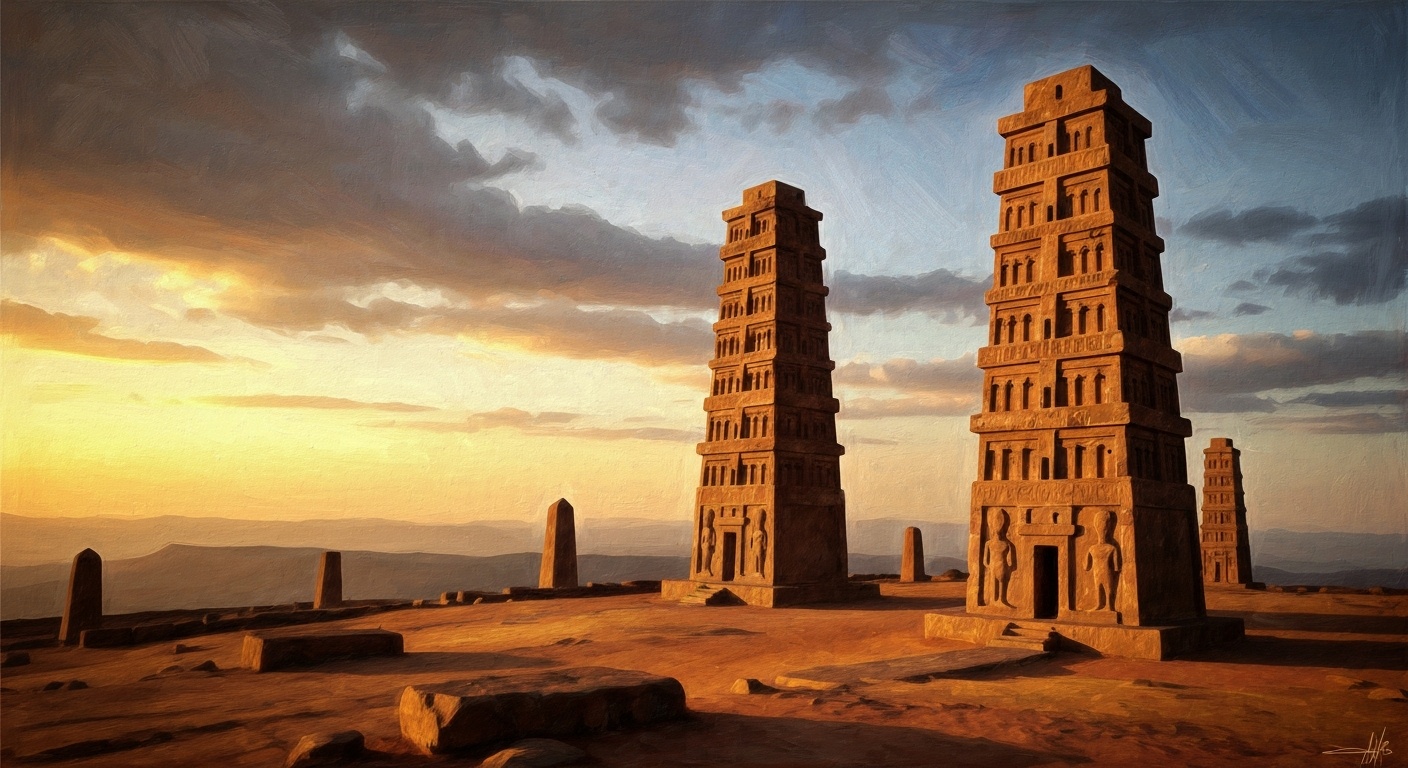
Before Egypt's pyramids became the default reference for "ancient Africa" in Western imagination, another civilisation built monuments that reached toward the sky. The Kingdom of Aksum—flourishing from roughly 100 to 940 CE in what is now northern Ethiopia—offers African fantasy writers something Egypt cannot: a legacy still living in Ethiopian Orthodox tradition, architecture, and cultural memory.
The Historical Aksum: Africa's Forgotten Superpower
Aksum wasn't a minor kingdom. At its height, it ranked among the world's four great powers alongside Rome, Persia, and China. This East African civilisation:
- Controlled international trade linking Africa, the Mediterranean, Arabia, and India through the Red Sea port of Adulis
- Minted its own currency—gold, silver, and bronze coins that circulated across three continents
- Developed a unique script (Ge'ez) still used in Ethiopian liturgy today
- Adopted Christianity in the 4th century, making it one of the world's oldest Christian states
- Built monumental architecture that still stands after 1,700 years
Located in Ethiopia's Tigray region at elevations often exceeding 2,000 metres, Aksum's highlands created a natural fortress—comparable to the Drakensberg's escarpment in Southern Africa. This geography of height, combined with abundant resources and strategic position, made the kingdom both wealthy and defensible.
The Stelae: Stone Towers That Touched Heaven
Aksum's most striking legacy is its monumental stelae—carved stone towers that archaeologists still struggle to fully explain. These weren't simple obelisks. They were:
- Monolithic: Each stele carved from a single block of granite
- Massive: The largest standing stele today reaches 23 metres; a fallen one would have stood 33 metres
- Architectural: Carved to resemble multi-storey buildings, complete with false doors and windows
- Anchored: Underground bases and counterweights stabilised these impossible towers
The stelae marked royal tombs, transforming burial sites into vertical bridges between earth and sky. They functioned as memory architecture—encoding royal lineages and historical narratives in stone that would outlast generations.
"The stele doesn't simply mark where the king lies. It declares that the king has not ended—that his presence extends upward, connecting the buried past to the living sky. The stone remembers what flesh forgets."
Aksum's Influence on African Fantasy
For fantasy writers seeking alternatives to European medieval settings, Aksum offers rich material:
Architecture of Memory
The stelae's function—storing memory in stone, creating visible links between past and present—translates naturally into fantasy concepts like memory crystals, ancestral archives, or consciousness technology. The idea that stone can hold knowledge isn't invented; it's inherited from Aksumite practice.
Religious Syncretism
Aksum blended Judaic, Christian, and indigenous African traditions into something unique. Ethiopian Christianity claims the Ark of the Covenant rests in Aksum. This fusion of Abrahamic and African elements provides models for fantasy religions that feel both familiar and distinctly African.
Trade Network Cosmopolitanism
Aksum wasn't isolated. Its merchants traded with Rome, Persia, India, and Arabia. This cosmopolitanism—an African civilisation at the centre of global exchange—counters narratives of African isolation and provides settings for fantasy that is both rooted and connected.
RESONANCE and the Aksumite Legacy
In RESONANCE by Sitreyah Kotelo, Aksum appears as a centre of Solarian wisdom—repositories of light, memory, and cross-cultural exchange. The novel's Resonance Stones directly echo Aksum's stelae:
- Both are crystalline/stone structures that store consciousness and memory
- Both extend unseen into deeper realms—the stelae's underground bases mirror the Stones' metaphysical depths
- Both function as vertical bridges connecting what is buried to what reaches skyward
- Both hold the Line of Remembrance—genealogies of consciousness extending across time
This isn't appropriation. It's continuation—African fantasy drawing on African architectural and spiritual traditions rather than borrowing European models.
The Spiritual Technology of Stone
Across African traditions, stone isn't inert matter. It's a living archive:
- San rock art sites function as permeable veils to the spirit world—paintings mark where shamans crossed over
- Initiation stones in Sotho and Nguni traditions test and acknowledge those undergoing transformation
- Aksum's stelae encode royal presence, making the dead perpetually available to the living
Fantasy that understands stone as memory technology taps into something authentically African. The Resonance Stones in Kotelo's novel aren't magical McGuffins invented for plot convenience—they're expressions of how African consciousness has always understood the relationship between matter and memory.
Why Aksum Matters for African Fantasy
When African fantasy writers reach for ancient civilisations, they're often funnelled toward Egypt—a civilisation claimed, contested, and partly erased from "Black Africa" by colonial scholarship. Aksum offers something different:
- Uncontested African identity: No one disputes that Aksum was an African civilisation
- Living tradition: Ethiopian Orthodox Christianity maintains direct continuity with Aksumite religion
- Unique aesthetics: Aksumite architecture looks nothing like Egyptian, Greek, or European models
- Documented history: Unlike many ancient African civilisations, Aksum left extensive records
For readers and writers tired of pseudo-medieval European fantasy, Aksum provides a documented, architecturally stunning, spiritually rich alternative that is entirely African.
Finding Aksum in Fiction
The growing wave of African fantasy increasingly draws on Ethiopian and broader East African traditions. Look for stories featuring:
- Stone monuments that hold memory or consciousness
- Highland settings with thin-place geography
- Synthesis of Abrahamic and African spiritual traditions
- Trade networks connecting Africa to wider worlds
- Architecture that reaches upward—towers, stelae, vertical sacred spaces
These elements signal writers engaging with Aksumite legacy, whether explicitly named or not.
Where Ancient Memory Meets Story
RESONANCE by Sitreyah Kotelo draws on Aksumite traditions of memory architecture to create a fantasy where stone holds consciousness and the Line of Remembrance connects all who came before to all who will come after. An Afro-Hebraic epic grounded in real African sacred geography.
$4.99 / £3.99 / R89
Discover RESONANCE