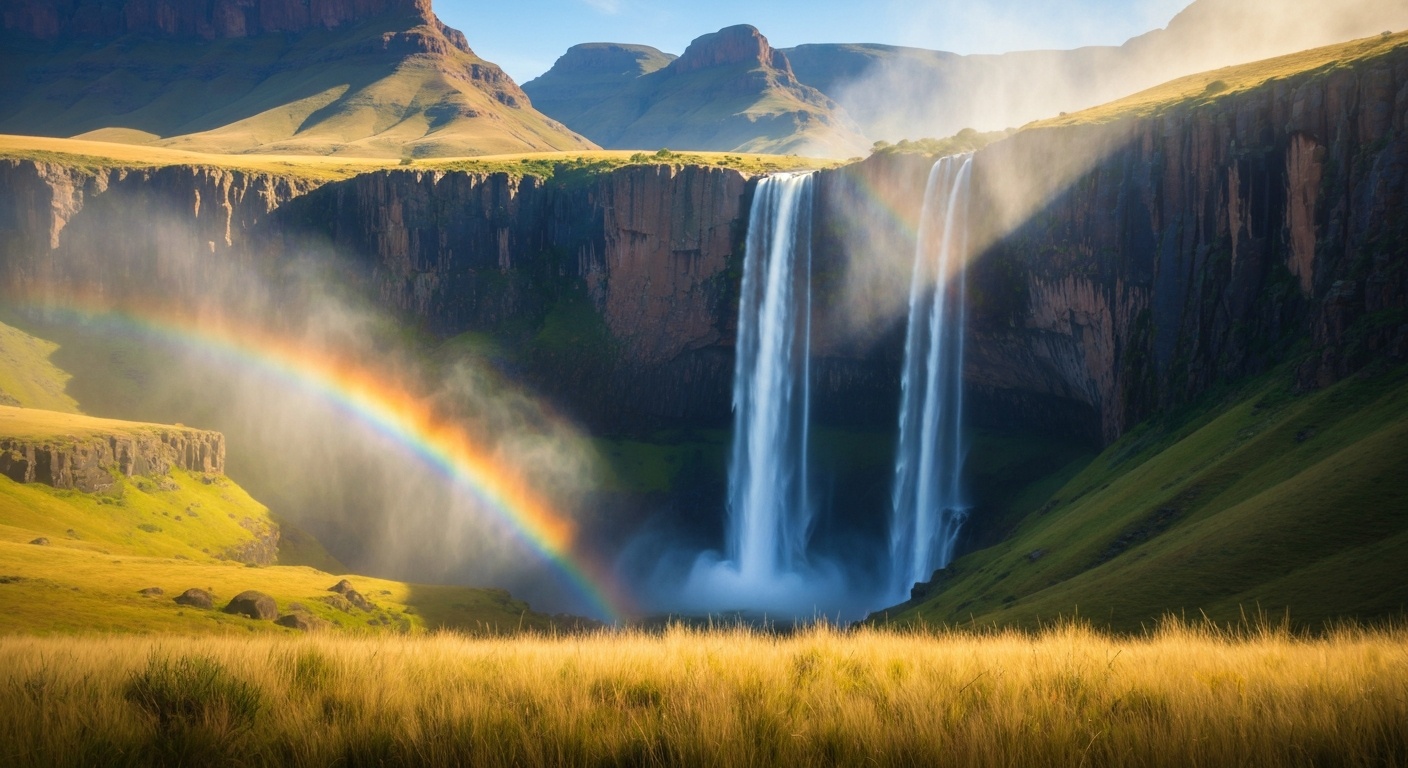
When South African readers encounter fantasy set in generic pseudo-European kingdoms, something feels off. The castles don't fit our sky. The forests don't smell right. The seasons are backwards. But when fantasy grounds itself in Mzansi's actual landscapes—the Drakensberg's basalt cliffs, the highveld's golden grass, the lowveld's thornveld savanna—something clicks. The story feels like home wearing mythological clothes.
The Tugela Watershed: Where Water Falls from Heaven
The Tugela Falls in KwaZulu-Natal drops 948 metres from the Drakensberg escarpment—the world's second-highest waterfall. But statistics don't capture what this place means to those who've stood in its mist.
The Tugela watershed has shaped Southern African history for centuries:
- Zulu, Basotho, and San communities have held these highlands as sacred for generations
- The escarpment forms the natural border between South Africa and Lesotho—a geographical and political boundary
- The Thukela River (fed by these falls) flows to the Indian Ocean, connecting highland to coast
- During times of conflict, these mountains offered refuge and resistance
In indigenous understanding, waterfalls aren't just pretty scenery. They're liminal spaces—thresholds where water transforms from river to mist to river again. Where the solid becomes vapour. Where crossing over happens.
South Africa's Climate Zones as Fantasy Realms
South Africa contains remarkable climatic diversity in relatively compact geography. This diversity maps naturally onto fantasy worldbuilding:
The Highveld (1,500–2,100m)
The interior plateau—Gauteng, Free State, parts of Mpumalanga—with its temperate climate, dry winters, and vast grasslands. In fantasy terms: austere, exposed, a place where nothing hides. The kind of landscape that strips pretence away.
The Lowveld and Bushveld (600–900m)
Hotter, with mixed woodland savanna stretching into Kruger and beyond. Fertile, dangerous, full of life. In fantasy: the wild spaces where untamed things flourish, where the boundaries of civilisation thin.
The Cape Fold Mountains
Ancient ranges with Mediterranean climates, fynbos vegetation found nowhere else on Earth. In fantasy: places of unique power, ecosystems that exist in isolation, harbouring species and secrets unknown elsewhere.
The Drakensberg Escarpment
The backbone of Southern Africa, where the high plateau breaks into cliffs and valleys. In fantasy: the wall between worlds, the high places where encounters with the divine become possible.
RESONANCE: Mzansi Landscape as Mythological Setting
RESONANCE by Sitreyah Kotelo transforms these real geographies into mythological landscape. The novel's Tugella village draws directly from the Tugela watershed—a place where "the boundary between physical world and pure spirit had worn thin through generations of focused intention."
Key landscape elements in RESONANCE that echo real SA geography:
- The sacred mountain—modelled on Drakensberg peaks, a thin place where initiation occurs
- Ceremonial stone circles—reflecting real archaeological sites across Southern Africa
- Water sanctuaries—honouring how indigenous communities treat rivers and falls as spiritual sites
- The contrast between harsh highlands and fertile lowlands—mirroring SA's actual elevation zones
"The mist didn't obscure—it revealed. What seemed like blinding white showed him more than clear sight ever had. The mountain wasn't hiding things. It was deciding what he was ready to see."
Why Real Geography Matters for SA Fantasy
When South African writers ground fantasy in actual Mzansi landscapes, several important things happen:
Recognition
Readers from Johannesburg recognise the highveld's quality of light. Durbanites know that humid coastal air. People who've hiked the Berg feel the altitude in the prose. This recognition creates emotional intimacy impossible in generic fantasy settings.
Validation
Indigenous communities have always known these landscapes as sacred. Fantasy that treats SA geography as worthy of mythological status validates knowledge systems that colonialism tried to erase.
Resistance
The Drakensberg and other mountain ranges historically offered refuge from conquest. Using these geographies in fantasy connects present stories to historical patterns of resistance.
Decolonisation
Every fantasy set in pseudo-Europe reinforces the idea that Africa isn't suitable for epic stories. Every fantasy rooted in African geography reclaims imaginative space.
The Land Remembers
In African spiritual understanding, land isn't passive backdrop. It remembers. It witnesses. It participates.
This understanding shapes how the best South African fantasy treats landscape:
- Battlefields don't just hold bones—they hold memory, trauma, the echoes of what happened
- Sacred sites aren't sacred because humans declared them so—the land's own character drew spiritual attention
- Rivers don't just provide water—they connect communities, carry messages, serve as highways for both physical and spiritual travel
- Mountains don't just create weather patterns—they watch, test, and occasionally reveal
RESONANCE embraces this understanding. The landscape doesn't merely provide setting—it teaches, judges, and transforms those who traverse it.
Reading Mzansi Fantasy
For readers seeking South African fantasy that honours real landscapes, look for:
- Specific geographical details (elevation changes, vegetation types, seasonal patterns)
- Weather that matches actual SA climate zones
- Indigenous place-relationships (not just European mapping onto African land)
- Land that acts—that remembers, reveals, resists
- Recognition moments where you think "I know that light" or "I've felt that wind"
These aren't just aesthetic choices. They're political acts—claiming African geography as worthy of epic storytelling, validating indigenous land-knowledge, and imagining futures rooted in actual place rather than imported settings.
From Here, Not There
The growing wave of South African fantasy represents something important: stories emerging from this land rather than imposed onto it. When the Tugela Falls becomes a threshold between worlds, when the Drakensberg holds ancient wisdom, when the highveld's vast skies reflect characters' spiritual states—these aren't decorative choices.
They're acts of belonging. Of claiming. Of coming home to imagination rooted in the actual earth beneath our feet.
Fantasy Rooted in Mzansi Soil
RESONANCE by Sitreyah Kotelo transforms South African sacred geography into epic fantasy. From the mist-shrouded heights of Tugella to the ceremonial landscapes of the highveld, this is Mzansi reimagined as mythological space—where the land remembers and the ancestors speak through stone.
$4.99 / £3.99 / R89
Experience Mzansi Fantasy