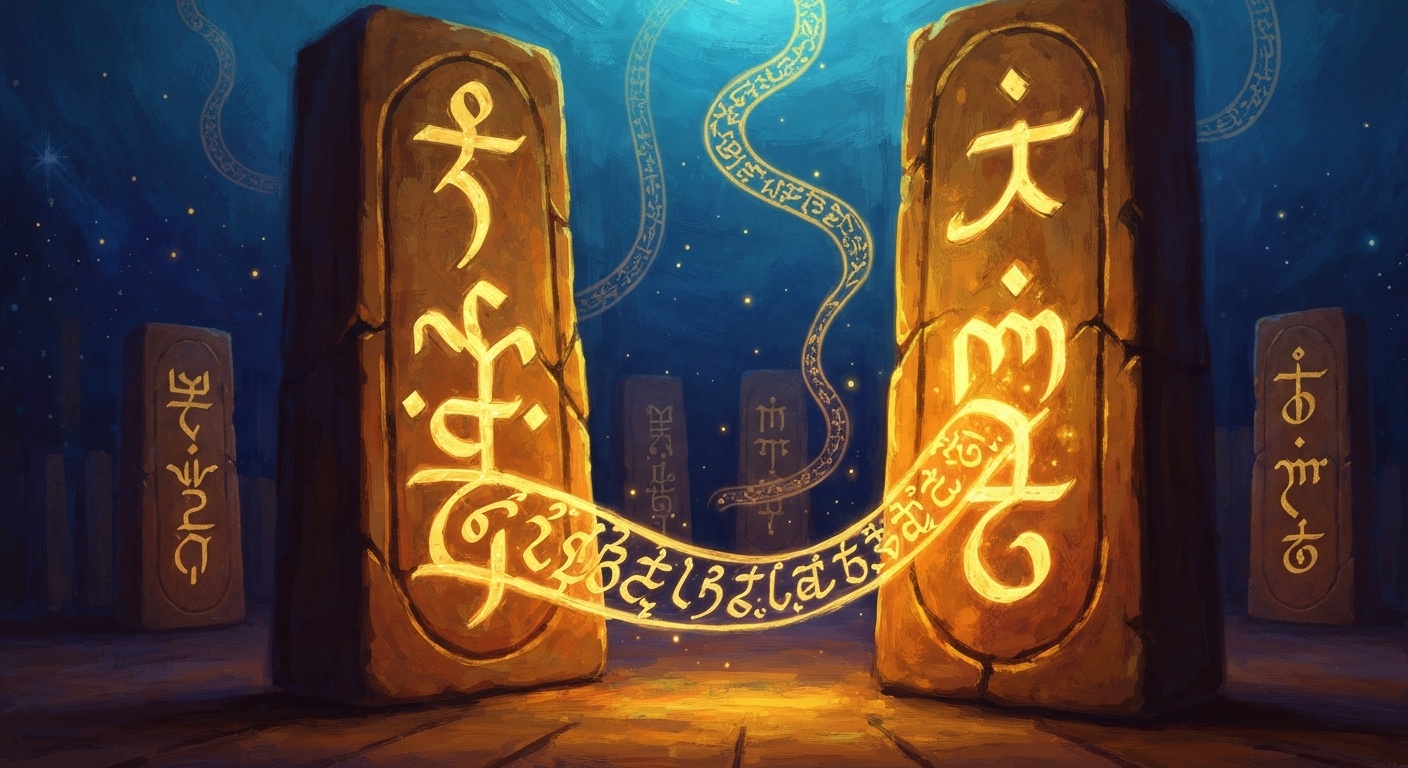
You've read Tolkien's Elvish. You've encountered Dothraki. You've puzzled over invented tongues crafted for fantasy worlds. But what if the most powerful fantasy language wasn't invented at all—but inherited from a thousand years of living tradition?
The best African fantasy doesn't need to invent languages. It draws from Sesotho, Setswana, isiZulu, Yoruba—tongues that have carried sacred knowledge, philosophical concepts, and cosmological understanding for generations. When these languages appear in fantasy, something remarkable happens: the made-up world suddenly connects to deep, living roots.
The Problem with Invented Languages
Don't misunderstand—Tolkien's linguistic achievement was extraordinary. He was a philologist who built Elvish from Indo-European roots with scholarly rigour. But most fantasy "languages" are surface decoration: a few exotic-sounding words scattered for flavour, signifying otherness without carrying meaning.
African fantasy writers face a different situation entirely. They inherit languages that already do what fantasy languages aspire to do:
- Encode worldview: Sesotho's noun-class system organises reality differently than English
- Carry spiritual weight: Words like seriti (spiritual presence/aura) have no English equivalent
- Sound ancient: Because they are ancient—centuries of oral tradition refined these sounds
- Connect to living community: Millions of speakers keep these languages vital and evolving
Why invent when you can inherit?
Sesotho: The Language of Power in RESONANCE
Sesotho (Southern Sotho) is spoken by approximately 5.6 million people in South Africa and Lesotho. It belongs to the Sotho-Tswana language group and carries distinctive features that make it ideal for fantasy's spiritual register.
In RESONANCE by Sitreyah Kotelo, Sesotho functions as the language of high consequence. When elders speak truth, when rituals are performed, when cosmic stakes are invoked—the text shifts into Sesotho:
"Empa Lejoe la Khopotso le ke ke la tlosoa ka likhoka, le ke ke la senngoa ka boithatelo."
"But the Stone of Remembrance cannot be removed by force, cannot be destroyed by will."
This isn't decoration. It's a reversal of colonial language hierarchy. In RESONANCE's world—as in much of real Southern Africa—English is the language of bureaucracy, commerce, and surface interaction. But when power speaks, it speaks Sesotho.
What Makes These Languages "Fantasy-Ready"
Sesotho and Setswana share features that fantasy writers dream of:
Agglutinative Structure
Words are built by layering prefixes and suffixes around root stems. A single word can carry meaning that requires an entire English phrase. This creates density—the feeling that each word contains worlds.
Noun-Class System
Prefixes like le-, mo-, ma- don't just indicate singular/plural. They encode categories of being—grouping concepts by their nature rather than arbitrary grammar. This organises reality according to African ontology, not European.
Semantic Layering
Words carry social, spiritual, and relational meanings beyond dictionary definitions. Botho doesn't just mean "humanness"—it means humanity-through-relationship, the ethical foundation of personhood. Seriti isn't just "shadow"—it's spiritual weight, presence, the mark you leave on the world.
Code-Switching as Narrative Technology
In multilingual Southern Africa, speakers naturally shift between languages depending on context. RESONANCE uses this real-world pattern as narrative technology:
- Sesotho/Setswana for ritual, elder wisdom, and metaphysical truth
- English for narrative exposition, Dominion bureaucracy, and rationalist discourse
The effect is powerful: indigenous language becomes the register of depth and authenticity, while English—historically the coloniser's tongue—is relegated to surface description. Readers feel this hierarchy even if they don't consciously analyse it.
"When the Stone Shapers speak of eternal things, they do not speak in the conqueror's language. They speak in the tongue their ancestors used to name the stars."
For International Readers: An Invitation
If you're reading African fantasy from the UK, US, or elsewhere, you might encounter unfamiliar words. This is by design. The slight friction—the pause to absorb a term you don't immediately know—mirrors the experience of entering a genuinely different worldview.
You're not meant to have instant access. You're meant to learn. To sit with the word Botho until you understand why "Ubuntu" became globally famous. To hear Lefika (rock/stone) and recognise why a character named "The Rock" carries destiny in his name.
This is what authentic diversity in fantasy looks like: not European structures with African window-dressing, but African structures that invite you to expand your frame.
The Decolonial Power of Language Choice
For too long, fantasy's "common tongue" defaulted to English or English-adjacent invented languages. African fantasy that centres indigenous languages makes a statement:
- African languages are complete—capable of expressing any concept, including the metaphysical
- African philosophy is primary—not derivative of European thought
- Power has always spoken African tongues—colonialism was an interruption, not an origin
When you read RESONANCE and encounter Sesotho, you're not reading "local colour." You're reading the language in which cosmic truths are told.
Experience African Languages in Epic Fantasy
RESONANCE by Sitreyah Kotelo weaves Sesotho and Setswana throughout an epic narrative of consciousness, memory, and transformation. Hear the languages of Southern Africa speak cosmic truth.
$4.99 / £3.99 / R89
Begin Reading